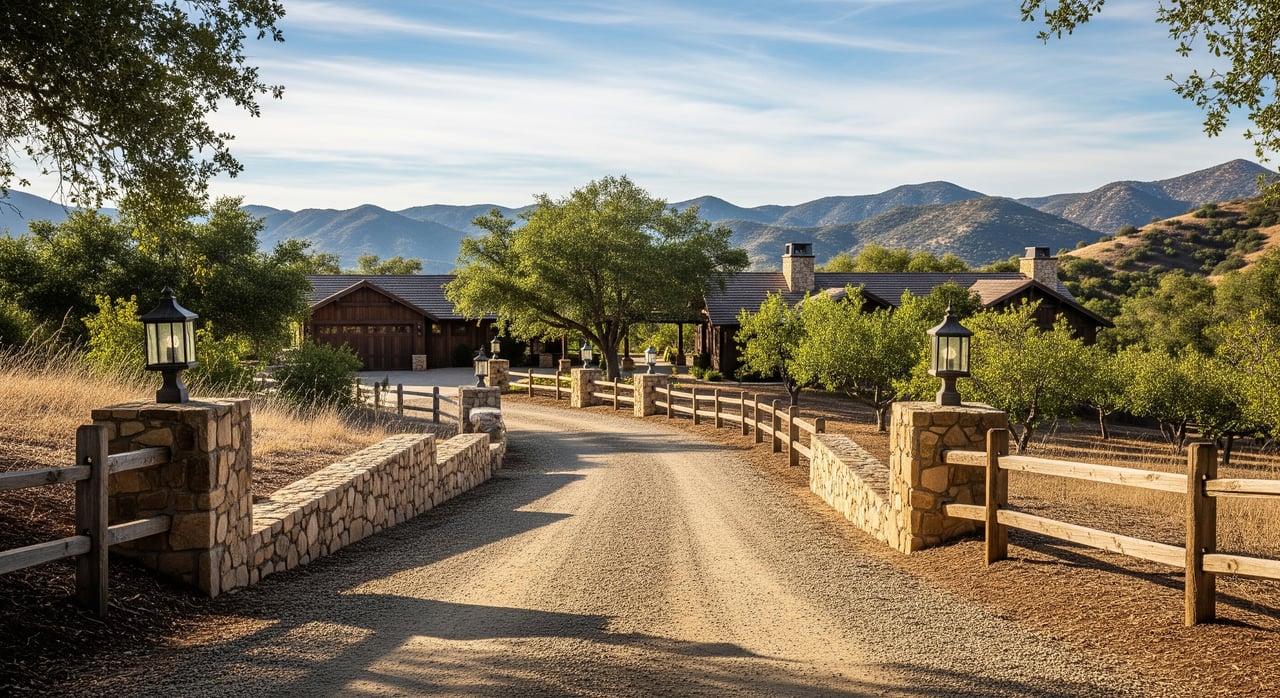
Do you share a dirt lane or paved driveway in Julian and wonder who fixes it or how to split the bill fairly? You’re not alone. Many Julian roads are private, and sorting out maintenance can be confusing when multiple neighbors rely on the same access. In this guide, you’ll learn how to tell if the county maintains your road, the main ways Julian owners share costs, what California law says when there’s no agreement, and how to plan a smart budget. Let’s dive in.
Is your Julian road public or private?
Julian is in unincorporated San Diego County. Some roads are county maintained, but many are private and fall to property owners or a local assessment district.
- Start by checking the County Maintained Road System. If a road is not listed, the county generally cannot spend public funds on it. Use the county’s Road Register and FAQ to confirm status by segment. See the county’s road maintenance FAQ.
- If a road is private, it may still be funded through a Permanent Road Division, or PRD. PRDs are special districts that collect assessments on property tax bills to maintain specific roads. View PRD maps and zones.
How PRDs work in Julian
A PRD is a county‑administered district formed by the affected property owners to fund construction and long‑term maintenance for a defined set of private roads.
- Owners vote to form the district, and the adopted budget becomes an assessment on tax bills.
- Costs are allocated using an approved formula, often called benefit units, parcel frontage, or a similar method set at formation.
- San Diego County administers the program and publishes budgets, maps, and contacts. Explore the PRD program overview.
Julian examples
Julian includes multiple PRDs, such as PRD 16 Wynola and PRD 18 Harrison Park. County pages provide boundary maps, miles maintained, culvert counts, and committee contacts. For instance, the county posts the PRD 16 Wynola boundary and details.
Private, neighbor‑led options
Not every private road is in a PRD. Many neighbors manage maintenance themselves.
- Road maintenance agreements: You can record an agreement that sets duties, budgets, allocation, and enforcement. This document runs with the land and helps avoid disputes.
- Voluntary road associations or HOAs: Neighbors may form a nonprofit or use CC&Rs to collect dues and hire contractors. Recorded obligations offer stronger enforcement. For practical guidance on agreement terms, see this overview of private road maintenance agreements.
When there’s no agreement: California’s default rule
If multiple parcels share a private easement or right‑of‑way and there is no written agreement, California Civil Code section 845 requires owners to share maintenance costs in proportion to their use. It also allows owners to seek contribution in court if others refuse to pay. Because “proportionate use” can be interpreted in different ways, a recorded agreement is usually the cleaner path. Read Civil Code section 845.
Common cost‑sharing methods
You’ll see several fair and workable approaches in Julian. Pick the one that matches your documents and road type.
- Benefit units or special‑assessment formula: Typical for PRDs; assigns charges based on parcel characteristics or defined benefit.
- Front footage: Splits costs by the linear feet each parcel fronts on the private road.
- Equal shares or by lot size: Simple splits for small groups of neighbors.
- Proportionate to use: The legal fallback under section 845 when no agreement exists.
Safety and emergency access standards
Private roads used for emergency access must meet minimum width, surfacing, and turn‑around requirements. In a wildland interface community like Julian, these rules protect life and property. The County Fire Code adopts standards for fire apparatus access roads, and authorities can require improvements for safety or permit approvals. Review the San Diego County fire access standards reference.
Budgeting: what road work can cost
Road work costs vary widely by scope, length, and site conditions. Use ranges and get local bids before you budget.
- Agency examples show that a basic 2‑inch asphalt overlay can fall in the tens of thousands to low hundreds of thousands per lane‑mile, while more extensive reconstruction can reach the hundreds of thousands to over $1 million per lane‑mile. See the FHWA cost context.
- Locally, San Diego County’s resurfacing program often funds projects from the $100k to $1M range depending on length and scope, and recent lists included Julian segments like Frisius Road, Harrison Park Road, and Old Cuyamaca Road. For context, see the Julian Journal report on county resurfacing.
- PRD budgets show actual charges and fund balances for each district, which can help you calibrate expectations.
A simple checklist for Julian owners and buyers
Use this quick path to clarity before you buy or budget.
- Identify who maintains the road.
- Check the County Maintained Roads list. If it’s not listed, assume it is private until confirmed otherwise. Use the county’s PRD maps to see if the parcel sits inside a PRD.
- Review title and recorded documents.
- Look for easements, CC&Rs, and maintenance agreements. If documents are silent, Civil Code section 845’s proportionate‑use rule applies.
- Talk with neighbors or a road committee.
- If you are in a PRD, contact the committee listed on county pages. If not, ask neighbors about any association or informal cost‑sharing practices.
- If no arrangement exists, pick a path.
- Negotiate and record a maintenance agreement, form a road association, or explore PRD formation with County DPW.
- Confirm emergency access compliance.
- Make sure your road meets fire access standards for width, surfacing, turnouts, and clearance. Plan improvements if needed.
Disclosures and resale
Recorded maintenance agreements, HOA obligations, and PRD assessments typically show up in title work and affect the ongoing costs for owners. Share known road obligations and budgets with buyers and lenders early so everyone understands access, maintenance, and cost‑sharing expectations.
If you want local guidance on how a shared road might affect your next move in Julian, reach out to Steven Sladek for a straightforward game plan.
FAQs
County maintenance in Julian: How do I know if the county will fix my road?
- Use the County Maintained Roads list and Road Register; if your road is not listed, the county generally will not fund repairs, and a PRD or private arrangement is typical.
Cost disputes on private easements: Can I make my neighbor pay?
- If you have a recorded agreement, enforce it under the contract; without one, Civil Code section 845 allows actions to recover a proportionate share based on use.
PRD assessments in Julian: How are charges calculated?
- Each PRD’s formation report sets the apportionment formula, often benefit units, frontage, or a similar method, and annual budgets apply that formula to compute charges.
Emergency access on private roads: What standards apply in Julian?
- Fire apparatus access rules require minimum width, all‑weather surfacing, and turn‑around provisions; authorities can require upgrades for safety or permits.
Buying a home on a private road in Julian: What should I review?
- Confirm if the road is county maintained or in a PRD, read title and recorded agreements, speak with neighbors or the road committee, and verify emergency access compliance before you close.